Article content
The apprenticeship paradox
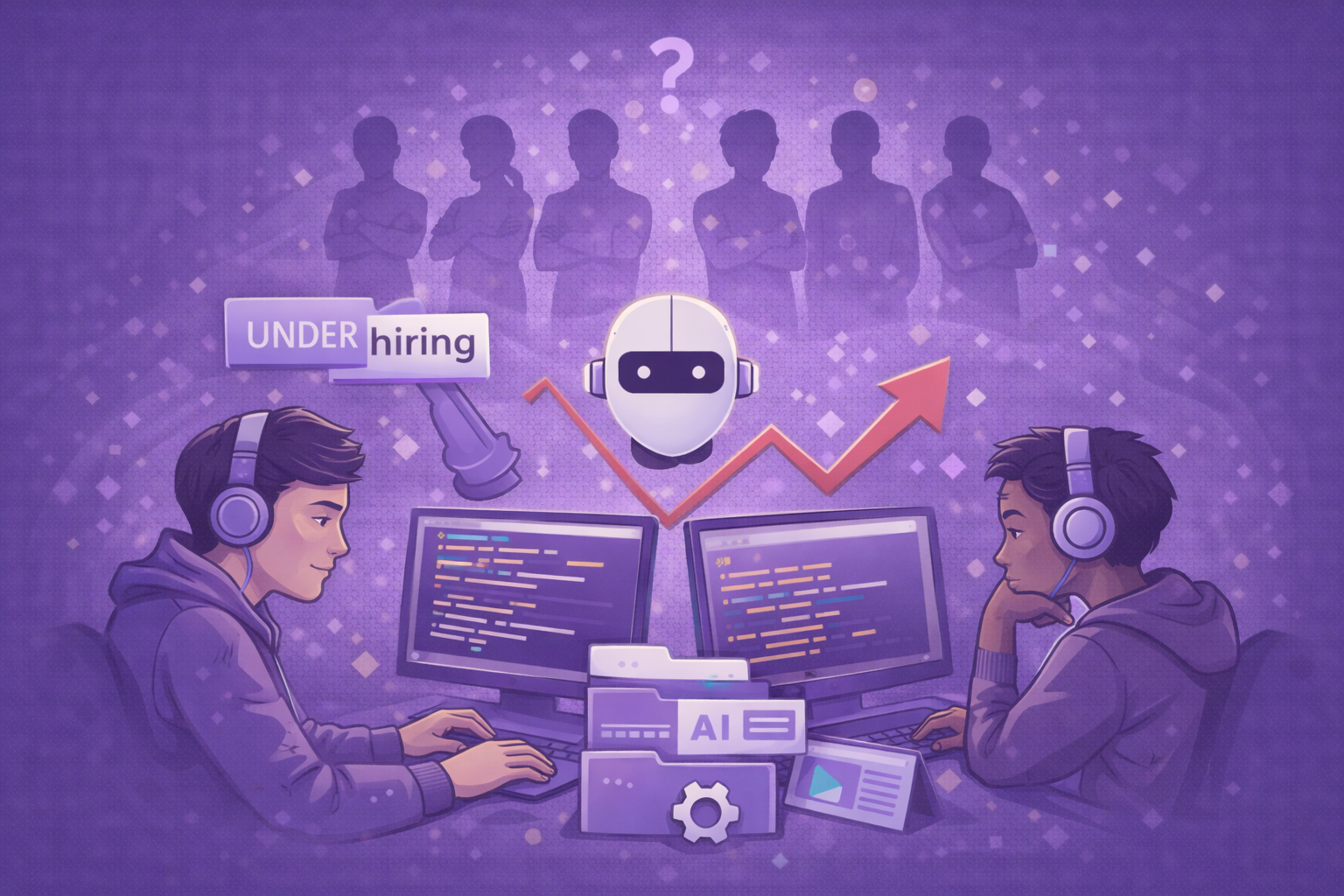
Companies don’t hire juniors because AI does those tasks better. But without junior developers today, who will lead teams in ten years?
There’s a question that rarely appears in quarterly reports: if we stop hiring people who are learning, who will know how to do this job a decade from now?
The numbers tell a story that should concern anyone managing technical teams. Employment for software developers between ages 22 and 25 has dropped 20% from the peak in late 2022, according to a paper from Stanford’s Digital Economy Lab based on payroll data from 25 million workers. It’s not a uniform decline: in the same period, employment for those over 35 in the same roles grew 8%.
The mechanism is what we might call the apprenticeship paradox: companies stop hiring entry-level because AI does those tasks better than a recent graduate. But without entry-level workers today, they won’t have senior engineers tomorrow.
The numbers of collapse
The contraction is not an impression. It’s documented by multiple independent sources.
Entry-level hiring at the top 15 tech companies dropped 25% between 2023 and 2024, according to SignalFire. Since 2021, the average age of technical hires has increased by three years. Companies aren’t just hiring less: they’re hiring differently, preferring senior profiles who can be productive from day one.
Tech internships have collapsed 30% since 2023, according to Handshake. Meanwhile, applications have increased 7%. More people competing for fewer positions, and the remaining positions require increasingly prior experience.
A Harvard study of 285,000 American companies found that when firms adopt generative AI, junior employment drops 9-10% within six quarters. Senior employment remains stable. These aren’t mass layoffs: it’s a silent hiring freeze. Companies simply stop opening entry-level positions.
The pattern repeats in Europe. Junior tech positions have dropped 35% in major EU countries during 2024, based on aggregated data from LinkedIn, Indeed, and Eures. In the UK, the Big Four consulting firms cut graduate hiring between 6% and 29% in two years. In India, IT companies have reduced entry-level roles by 20-25%, according to an EY report.
The World Economic Forum, in its Future of Jobs Report 2025, warns that 40% of employers expect to reduce staffing where AI can automate tasks. And automatable tasks are, almost by definition, the ones junior developers used to do.
The logic of the short term
The rationale behind these choices is understandable. A senior engineer with AI tools can do what previously required two or three juniors, at least for certain tasks. GitHub Copilot, Cursor, and similar tools promise productivity gains of 20-50% according to their vendors. For a CFO looking at the next quarter, hiring a junior who will need six months of training before being productive seems like a difficult investment to justify.
James O’Brien, a computer science professor at Berkeley who works with startups, describes the shift: “Previously, startups would hire one senior person and two or three early-career coders to assist. Now they ask: why hire a recent graduate when AI is cheaper and faster?”
It’s a reasonable question in the short term. Code generated by AI isn’t top quality, but neither is code written by a recent graduate. The difference, O’Brien notes, is that the iterative process to improve AI code takes minutes. A junior might take days for the same task.
Heather Doshay, head of talent at SignalFire, sums it up: “Nobody has the patience or time for hand-holding in this new environment, where much of the work can be done autonomously by AI.”
The problem nobody calculates
There’s a flaw in this logic, and it’s called the talent pipeline.
Matt Garman, CEO of AWS, said it explicitly: “If you don’t have a talent pipeline you’re building, if you don’t have junior people you’re mentoring and growing in the company, we often find that’s where the best ideas come from. If a company stops hiring juniors and developing them, eventually the whole system falls apart.”
It’s not rhetoric. It’s demographic mathematics applied to organizations. Every senior engineer, every tech lead, every CTO was once a junior. The path from recent graduate to technical leader requires years of experience on real projects, mistakes made and corrected, feedback received, patterns internalized. There is no shortcut.
If the industry stops hiring juniors in 2023, by 2033 it will have a structural shortage of mid-level talent. By 2038, there will be a shortage of senior engineers. By 2043, there will be no one to promote to technical leadership roles.
The problem is that this cost doesn’t appear in any quarterly balance sheet. It’s an invisible debt that accumulates silently, and when it becomes obvious, it will be too late to remedy quickly.
AI that teaches and AI that atrophies
There’s a further irony in this situation. The same AI tools that are eliminating junior roles could, in theory, accelerate learning. An AI tutor available 24/7, patient, answering every question: it sounds like every student’s dream.
The reality is more complicated.
An experiment conducted by Wharton and Penn researchers on nearly a thousand high school math students tested two versions of a GPT-4-based tutor. The group with access to a ChatGPT-like interface (GPT Base) achieved 48% better results during assisted practice sessions. The group with a tutor designed to guide without giving direct answers (GPT Tutor) achieved 127% better results.
But here’s the point: when AI was removed and students took the exam on their own, the GPT Base group achieved 17% worse results than the control group who never used AI. The GPT Tutor group, by contrast, achieved results similar to control.
Students were using AI as a crutch. They performed better with assistance but learned less. When the assistance was removed, they found themselves worse off than those who never had it.
A study from MIT Media Lab documented what researchers call “cognitive debt”: using LLMs for writing seems to reduce mental effort during the task, but at the cost of more superficial learning. Researcher Nataliya Kosmyna expressed concern about developing brains: “Developing brains are the ones at highest risk.”
It doesn’t mean AI can’t help learning. The Wharton study shows it can, if designed with the right safeguards. But “wild” AI, the kind that gives answers instead of guiding toward answers, can do damage.
The new profile of the junior
If fewer juniors will be hired, what characteristics must they have to be hired?
Market signals are clear. It’s no longer enough to know how to code. Employers expect recent graduates to be able to manage projects, communicate with clients, understand the software development lifecycle. The “grunt work” that once served as a training ground is being automated. Those entering must be operational at a higher level almost from day one.
Jamie Grant, who manages career services for engineering at the University of Pennsylvania, describes the change: “They’re not necessarily just programming. There’s much more high-level thinking and understanding of the software development lifecycle.”
David Malan of Harvard, who teaches the world’s most-followed introduction to programming course, notes that the biggest impact of AI has been on programmers, not on roles that were expected (like call centers). The reason: programming work is relatively solitary and highly structured, perfect for automation.
But Malan also notes something interesting: in the United States, employment for “programmers” dropped 27.5% between 2023 and 2025, but employment for “software developers,” a more design-oriented position, dropped only 0.3%. The difference is in the level of abstraction. Those who write code are vulnerable. Those who design systems less so.
Three scenarios for the future
Scenario 1: The collapse of the pipeline
Companies continue not to hire juniors. In five to ten years, the shortage of mid-level talent becomes acute. The remaining senior engineers command astronomical salaries. Companies that can’t afford them lose competitiveness. The industry polarizes between a few giants who can attract talent and everyone else struggling.
Scenario 2: Apprenticeship reinvented
Some companies realize the problem is coming and invest against the trend. They create intensive training programs, perhaps assisted by AI designed to teach instead of replace. They become the preferred employers for top talent, who know they can grow there. In the long term, they have a competitive advantage.
Scenario 3: Uneven democratization
AI lowers the barrier to entry for some skills (writing working code) but raises it for others (designing systems, debugging complex problems, managing AI itself). Those with access to quality training and mentorship can skip some steps. Those without remain stuck. Inequality of opportunity increases.
None of these scenarios is inevitable. They are possibilities that depend on choices companies, educational institutions, and policymakers will make in the coming years.
What those who hire can do
If you manage a team or influence hiring decisions, some questions deserve reflection.
Are you optimizing for the next quarter or the next ten years? A junior costs more in the short term. But the alternative is to depend entirely on the external market for talent, competing with everyone else who made the same choice.
Is your team still teaching? If senior people spend all their time producing and no one teaching, you’re consuming human capital without regenerating it.
How do you use AI in training? If your juniors use Copilot to get answers instead of learning to find them, you’re accelerating their short-term productivity while compromising their long-term growth.
Are you hiring for today’s skills or tomorrow’s adaptability? Specific technical skills have an increasingly short half-life. The ability to learn, to reason about new problems, to work with people—those last.
What those starting out can do
If you’re early in your career in a market that seems to close doors on you, some principles can help.
AI isn’t eliminating all junior work. It’s eliminating repetitive, isolated junior work. The roles that survive require human interaction, judgment about ambiguous problems, creativity applied to specific contexts. Look for those.
Learn to use AI as a tool, not a crutch. The difference between using ChatGPT to get answers and using it to explore problems is the difference between atrophying and growing.
Networking matters more than ever. If junior positions are scarce, competition is fierce, and often the person with a connection wins, not the person with the best CV. It’s not fair, but it’s real.
Cross-functional skills are not optional. Communication, project management, understanding the business: these are things AI can’t do and employers seek even in technical profiles.
The unanswered question
I return to the initial question: who will the senior engineers of tomorrow be?
I don’t have a certain answer. No one does. We’re conducting a real-time experiment, without a control group, on a global scale.
What I know is that every senior person I know was once a junior who someone decided to hire and train. Every tech lead made beginner mistakes that someone had the patience to correct. Every systems architect wrote embarrassing code before writing elegant code.
If we eliminate that phase, if we treat it as a cost to cut rather than an investment to protect, we’re not optimizing. We’re consuming capital that we don’t know how to regenerate.
The question isn’t whether AI can replace juniors. It can, for many tasks. The question is whether we want an industry that only knows how to consume skills or one that also knows how to produce them.
For now, the numbers suggest we’ve chosen the first option. The bill will come. Not next quarter. But it will come.
Sources
Brynjolfsson, E., Chandar, B., & Chen, R. (2025). Canaries in the Coal Mine: Six Facts about the Recent Employment Effects of AI. Stanford Digital Economy Lab.
Bastani, H., Bastani, O., Sungu, A., Ge, H., Kabakcı, Ö., & Mariman, R. (2024). Generative AI Can Harm Learning. The Wharton School Research Paper.
Stack Overflow. (2025, December). AI vs Gen Z: How AI has changed the career pathway for junior developers. Stack Overflow Blog.
IEEE Spectrum. (2025, December). AI Shifts Expectations for Entry Level Jobs.
Rest of World. (2025, December). AI is wiping out entry-level tech jobs, leaving graduates stranded.
Kosmyna, N., et al. (2025). Your Brain on ChatGPT: Accumulation of Cognitive Debt when Using an AI Assistant for Essay Writing Task. arXiv.
World Economic Forum. (2025). Future of Jobs Report 2025.
FinalRound AI. (2025). AWS CEO Shares 3 Solid Reasons Why Companies Shouldn’t Replace Juniors with AI Agents.